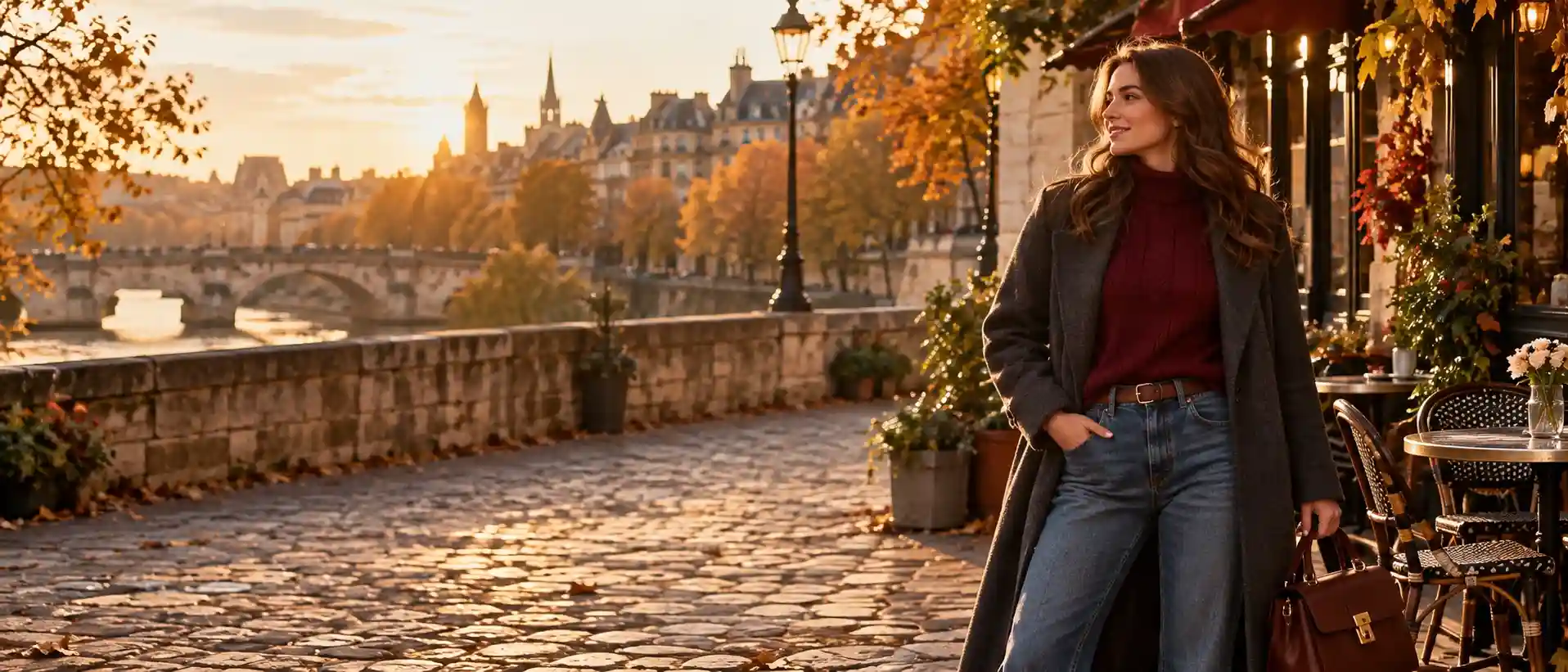
I packed for Paris in October with exactly one raincoat and zero backup plan. Big mistake.The forecast lied, my one coat got soaked by hour two, and I spent a chunk of my trip in a Uniqlo trying to fix a problem I could’ve avoided with better research.
So here’s that research, done for you.Fall in Europe is not one season. It’s five or six, depending on where you land and which week you show up. Lisbon in September still wants sundresses.
Prague in November wants a real coat and thermal socks. And your Pinterest board probably has ideas pulled from every city at once, which is how most of us end up overpacking or underpacking in equal, chaotic measure.
This guide breaks it down by aesthetic, not just by temperature. Cottagecore, dark academia, quiet luxury,
Parisian minimalism, Scandi knitwear, layered streetwear. Pick your lane, or steal from two. I do that constantly and nobody’s stopped me yet.
Bookmark this one. It’s long, it’s detailed, and I’d rather give you too much than send you off with a vague “pack layers” and call it a day.
I’ll walk through six different aesthetics, a weather cheat sheet, a fabric breakdown, and an actual sample week so you’re not just staring at a list of pretty pieces wondering how they fit together in real life.

Why European fall packing trips people up
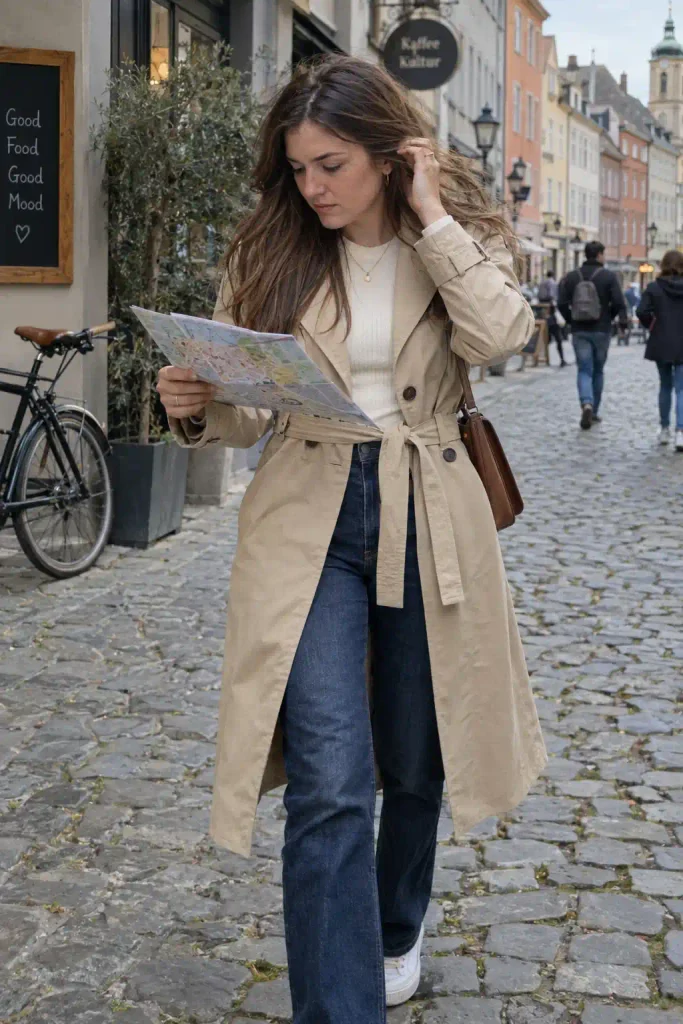
The weather swings hard. A morning in Amsterdam can sit around 10°C (50°F) while the afternoon climbs into the mid-teens, and that gap catches even seasoned travelers off guard, according to .
The Gap Decaders’ fall travel guide. Southern cities like Athens or Lisbon hold onto warmth longer, while Prague, Vienna, and anywhere near the Alps drop fast once October hits.
Then there’s the rain. UK and Northern France see it often in October, per Holidify’s regional weather breakdown,
which means your outfit needs a job beyond looking good. It has to survive a surprise downpour and still photograph well outside a café.
IMO that’s the real challenge of fall dressing in Europe. You’re not choosing between style and function. You’re finding pieces that quietly do both.
There’s also the trip-length problem. A three-day city break and a three-week multi-country trip need completely different packing logic.
Nobody tells you that until you’re standing in an Airbnb at midnight trying to zip a suitcase that won.
Quick temperature cheat sheet
| Region | Typical October Range | Pack This |
|---|---|---|
| Southern Europe (Spain, Italy, Greece) | 18°C to 24°C (64°F to 75°F) | Light layers, one cardigan |
| Western/Central Europe (France, Germany, Netherlands) | 10°C to 18°C (50°F to 64°F) | Trench coat, midweight knit |
| Northern/Alpine (Scandinavia, Austria, Scotland) | 5°C to 12°C (41°F to 54°F) | Wool coat, thermal base layer |
Screenshot that table before you pack. Future you will thank present you.
Mistakes I made so you don’t have to
Let’s get the honesty out of the way early.
I once packed four pairs of heeled boots for a ten-day trip through Italy. Four.
I wore one pair, on one night, for two hours, and spent the rest of the trip limping around Rome in the only sneakers I’d brought as a “just in case” backup.
Rookie move, and I should’ve known better.
A few other lessons, learned the hard way:
- Cotton dries slowly. A cotton hoodie that gets rained on stays damp for a full day. Wool and synthetic blends dry faster and weigh less in your bag.
- One “special occasion” outfit is enough. You don’t need three. Pick one dress or one blazer combo and rewear it with different accessories.
- Check the actual forecast, not the seasonal average. Averages lie. I’ve hit an unseasonably warm October in Berlin and an unseasonably cold September in Barcelona within the same year.
None of this is rocket science. It’s just the stuff nobody mentions until you’ve already made the mistake yourself, usually somewhere between a full suitcase and a very sore pair of feet.
How to layer without looking like the Michelin Man

Layering sounds simple until you’re standing in a hotel room at 7 a.m. wearing four shirts and still somehow cold.
The trick is thin layers, not bulky ones. A silk or merino base layer under a sweater takes up almost no space and adds real warmth.
Save the bulk for one statement coat, not five sweaters stacked on top of each other.
Here’s the order that’s worked for me on every European fall trip so far:
- A thin base layer (silk cami or fine merino tee)
- A mid layer with actual insulation (sweater, cardigan, or flannel)
- An outer layer built for weather (trench, wool coat, or packable rain shell)
- One accessory layer (scarf, gloves, beanie) you can add or remove without unpacking your whole bag
This isn’t complicated. It’s just three or four pieces working together instead of one heavy coat trying to do everything by itself.
The cottagecore wanderer

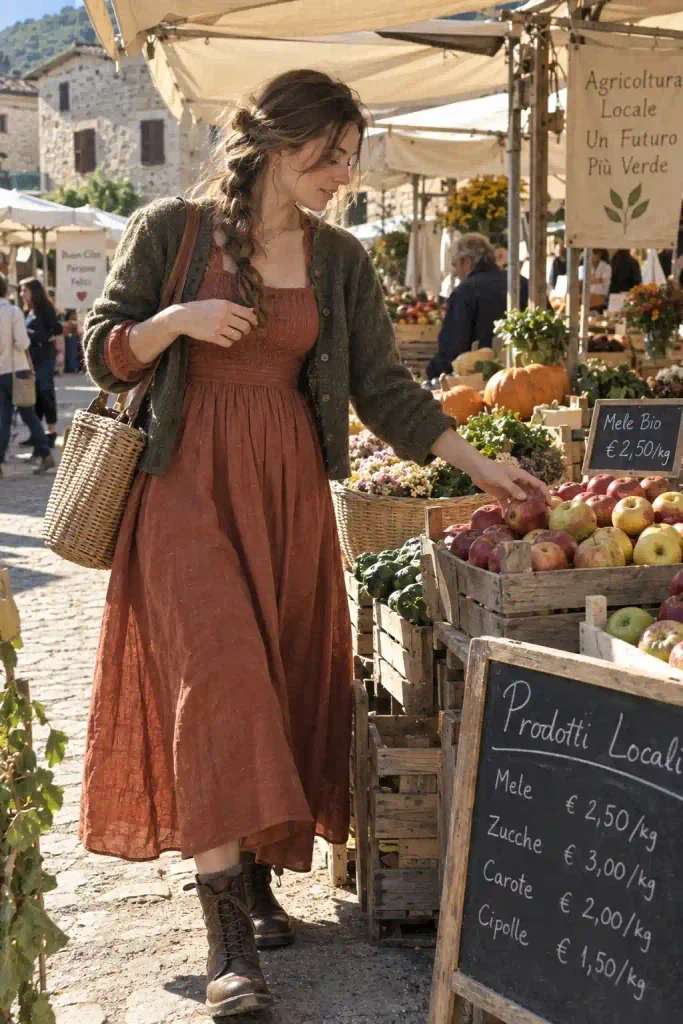
This aesthetic lives for vineyard walks, farmers markets, and looking like you just wandered out of a French countryside novel.
Think flowing midi skirts, puff sleeves, and boots that have clearly walked somewhere interesting.
Build it around:
- A prairie dress in a warm, muted print, layered over a fine-rib turtleneck
- A cropped wool cardigan in rust or moss
- Lace-up leather boots with a low, walkable heel
- A woven basket bag (yes, actually useful, not just decorative)
- A silk scarf tied around your neck or your bag strap
I wore a version of this in a small town outside Florence and got asked twice where I bought my dress. It was a $40 find from a vintage shop in Portland. Nobody needs to know that but you.
Personal opinion here: cottagecore reads best in real fabric. Polyester ruins the whole effect the second the light hits it wrong. Spend your budget on the dress and thrift everything else.
Where this aesthetic shines
Vineyard towns, countryside train stations, and anywhere with cobblestones and ivy.
Think Tuscany, the Loire Valley, or the Cotswolds. It looks a little out of place against glass and steel city architecture, so save it for the softer, older parts of your trip.
Dark academia, but make it wearable
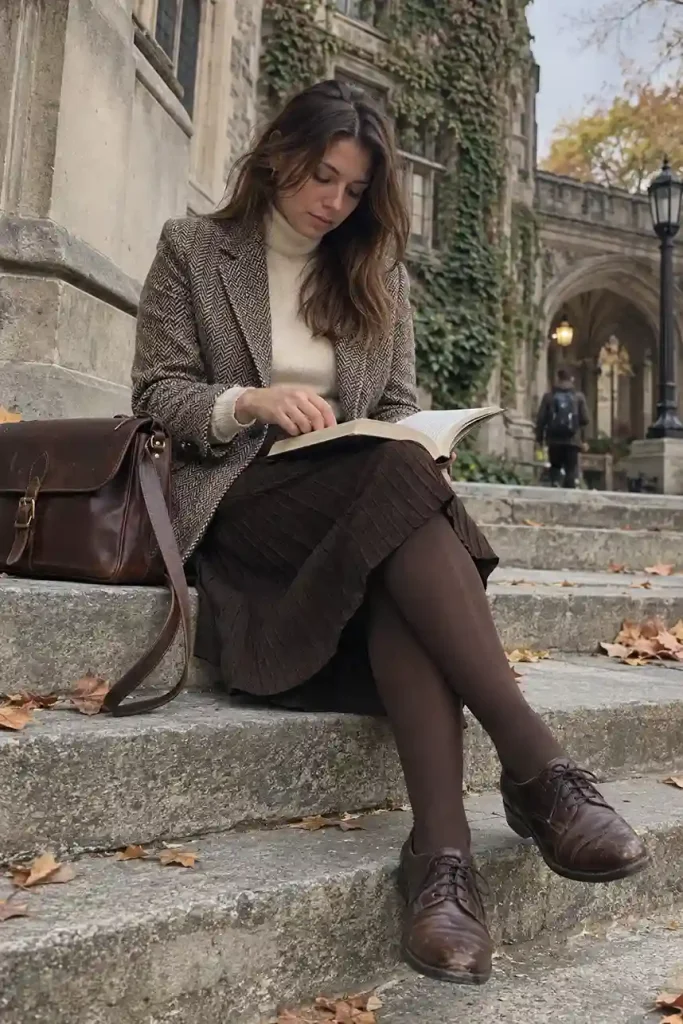
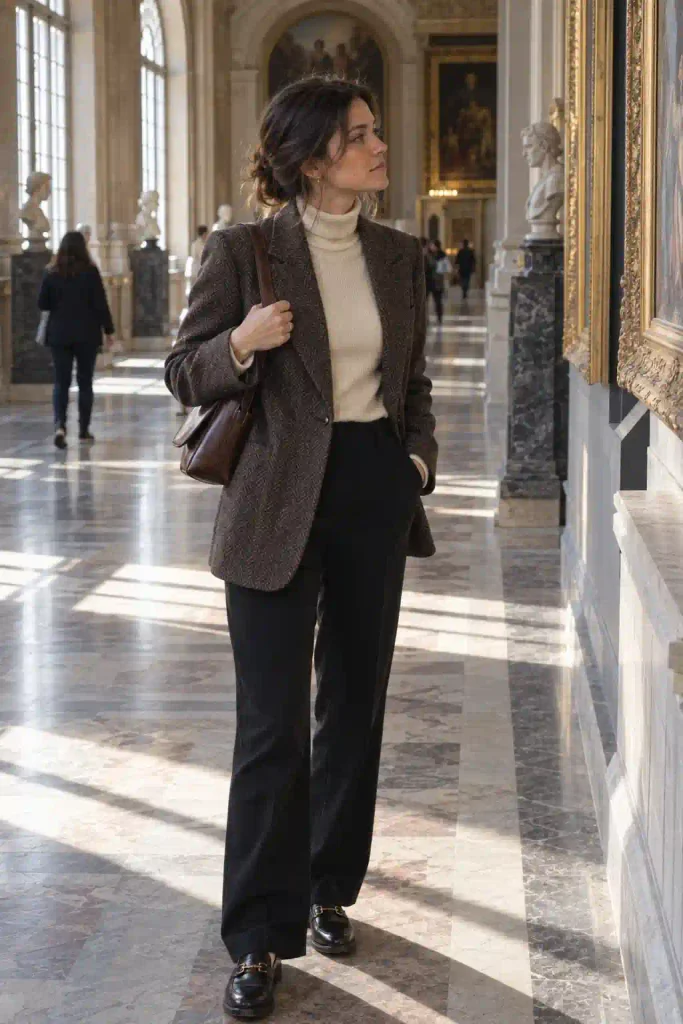
Dark academia gets treated like a costume online, all tweed blazers and library aesthetics.
In real life, in real European weather, it’s honestly one of the most practical looks on this list. Wool, plaid, and structured layers were basically invented for a Vienna autumn.
Core pieces:
- Oxford shoes or loafers (comfortable ones, you’ll be walking on cobblestone)
- A tweed or herringbone blazer
- A pleated wool skirt or straight-leg trousers
- A cream or ivory turtleneck underneath
- A leather satchel or structured tote
Ever wondered why this aesthetic photographs so well against old European architecture? It’s because the palette practically matches the buildings.
Brown stone, ivy, brass details, your outfit and the background start working together instead of fighting for attention.
One honest note: skip the full costume approach. A tweed blazer, jeans, and loafers reads more current than head-to-toe plaid.
I learned that one the hard way in Edinburgh, where I looked like I was cosplaying a professor instead of dressing like a person on vacation.
A small styling table for this one
| Occasion | Top Half | Bottom Half |
|---|---|---|
| Museum day | Turtleneck + blazer | Wool trousers |
| Café afternoon | Sweater vest over shirt | Pleated skirt |
| Evening dinner | Blazer, no undershirt fuss | Dark denim |
Old money and quiet luxury
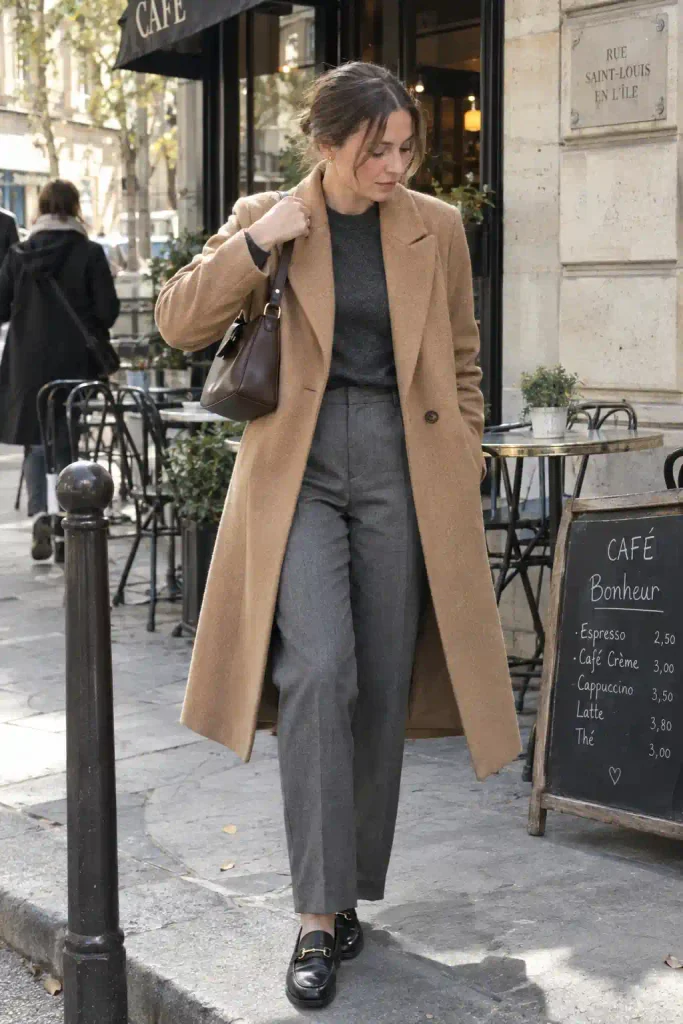
This is the aesthetic for museum mornings and long lunches. Clean lines, neutral palettes, nothing loud.
The whole point is that it looks expensive without shouting about it, which, honestly, takes more effort than people assume.
What it needs:
- A camel or beige wool coat, tailored, not oversized
- Straight or wide-leg trousers in navy or gray
- A cashmere or merino sweater, fitted, not baggy
- Loafers or ballet flats
- A structured leather bag, small, not overloaded
Table time again, because this one deserves a quick comparison:
| Piece | Budget Version | Splurge Version |
|---|---|---|
| Wool coat | H&M or Uniqlo wool blend | Max Mara or Aritzia |
| Loafers | Target or Everlane | G.H. Bass or Sezane |
| Cashmere sweater | Quince | Naadam |
That Quince cashmere pick is genuinely one of the best value buys in fashion right now.
I own three sweaters from them and they’ve held up better than pieces I paid triple for.
A small aside, since we’re on the topic of money: I used to think “quiet luxury” meant spending more.
It doesn’t. It means spending smarter on fewer, better-fitted pieces. Tailoring a $30 coat can look more expensive than an ill-fitting $300 one. Ask any stylist.
Parisian minimalist
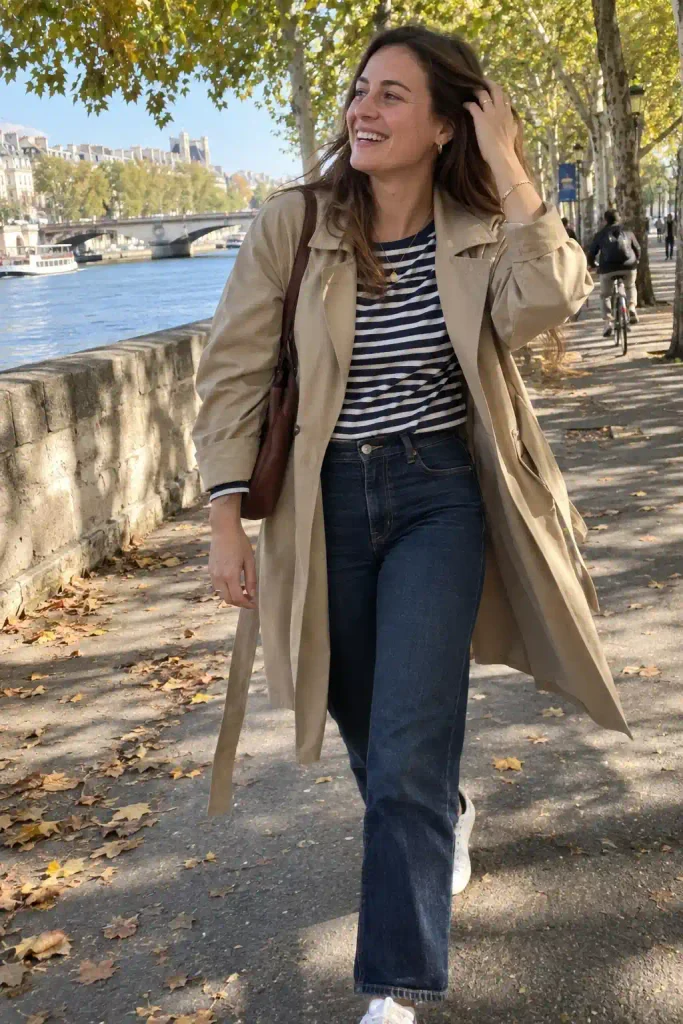
Less is doing a lot of heavy lifting here. This look leans on quality basics, a signature red lip, and a coat that could survive twenty years of wear without looking dated.
Rely on:
- A trench coat in beige or navy
- A striped or plain long-sleeve top
- Straight-leg dark denim
- Ballet flats or a clean white sneaker
- Gold jewelry, minimal, a few pieces max
This isn’t a hard aesthetic to nail, but it’s an easy one to overthink. The trick is restraint. One statement piece per outfit, tops. If your coat is doing the talking, let your jewelry sit quiet.
FYI, this is my personal go-to when I’m traveling for work and can’t overpack.
Six pieces, endless combinations, and I never look like I’m trying too hard. Which, ironically, takes a fair bit of effort to pull off.
Okay, random detour, but I have to say it: I once watched someone try to reenact an entire Pinterest board’s worth of “Parisian girl” content on the Seine, complete with a baguette prop she wasn’t going to eat.
It was funny and also kind of impressive commitment to the bit. Anyway, back to the outfits.
Cozy Scandinavian knitwear
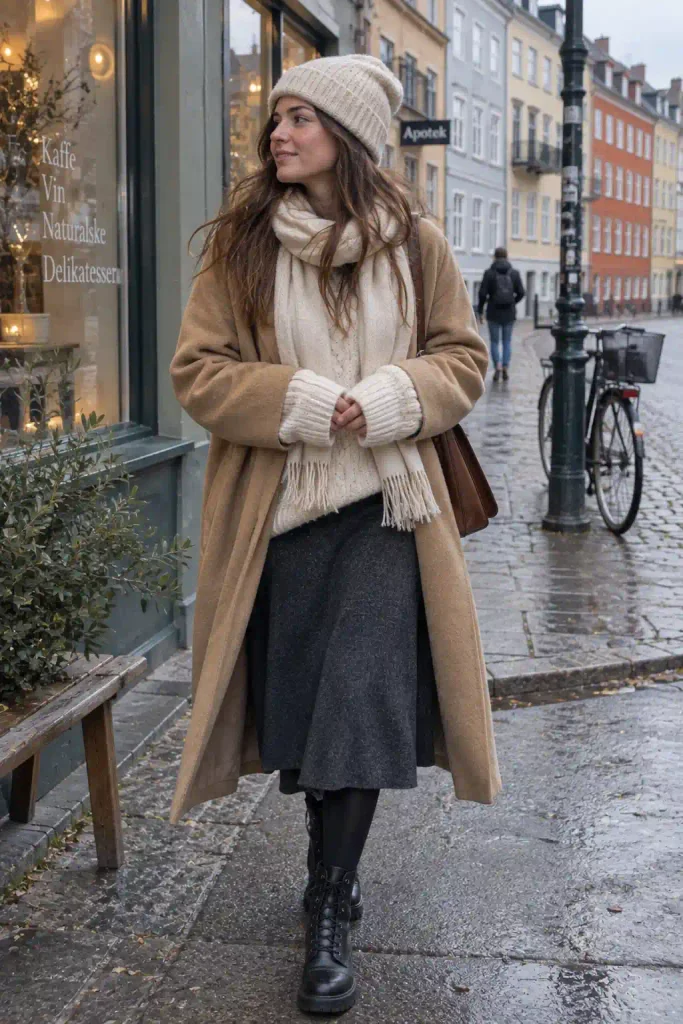
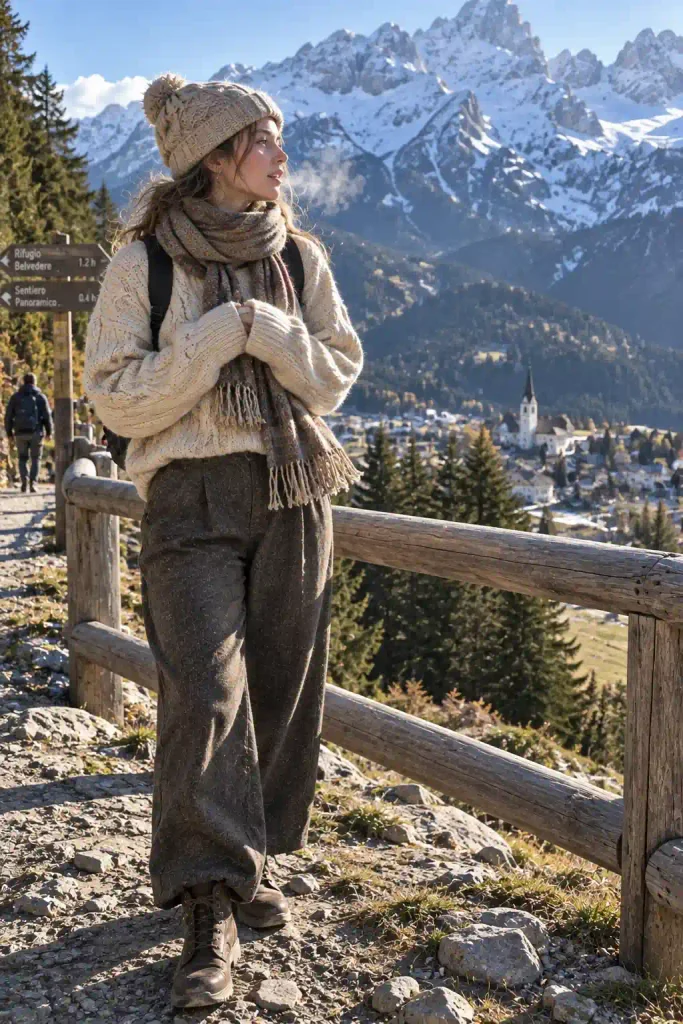
Somewhere between hygge and a ski lodge, this aesthetic is built for the colder pockets of Europe: Copenhagen, Stockholm, and anywhere the wind means business.
The essentials:
- A chunky cable-knit sweater, oversized on purpose
- Wide-leg wool trousers or a midi skirt with tights underneath
- A long wool coat, ideally in a soft neutral
- Combat boots or lug-sole loafers
- A knit beanie and matching scarf set
Wow, this look is genuinely the easiest one on the list to get right. Throw on a big sweater, add boots, and you’re basically done.
It’s forgiving, it’s warm, and it photographs beautifully against gray skies and colorful storefronts.
Layered streetwear for city hopping
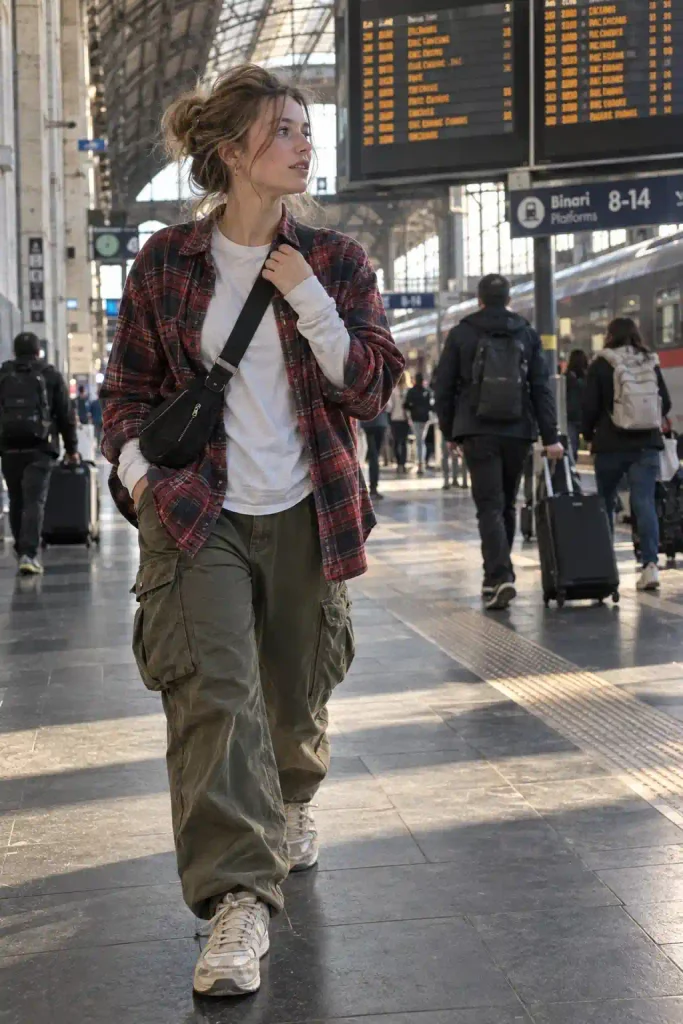
For the traveler bouncing between three or four cities in ten days, streetwear layering is the most practical option on this list.
It moves with you, it hides a travel-day wrinkle, and it doesn’t require ironing in a hostel bathroom.
Build the outfit like this:
- A graphic tee or plain long-sleeve as your base
- An oversized flannel or bomber jacket
- Cargo pants or relaxed-fit denim
- Chunky sneakers, broken in before the trip, not on day one
- A crossbody bag you can actually run through a train station with
This is the aesthetic that gets me through connecting flights and 6 a.m. train departures. Comfortable, layered, and honestly the least fussy option here.
This is also the look I’d personally recommend for anyone doing a fast multi-city trip.
Four cities in six days doesn’t leave much time for delicate fabrics that need careful handling.
The capsule wardrobe method, if you want to skip all this
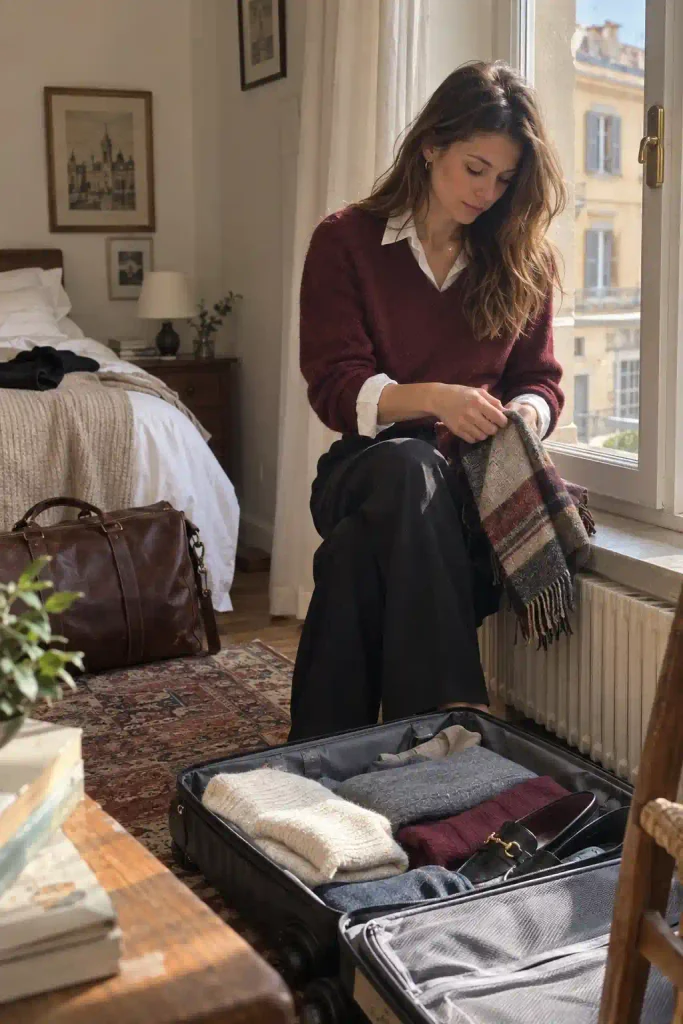
If choosing one aesthetic feels overwhelming, building a small capsule wardrobe solves most of the problem for you.
A well-planned fall capsule usually runs 10 to 14 pieces that all mix and match, which means fewer decisions and less luggage stress, as detailed in this fall capsule wardrobe breakdown.
My rule of thumb: three bottoms, five tops, two layers, two pairs of shoes. Everything in a shared color family so nothing gets left behind unworn.
A sample two-week capsule I’ve actually traveled with:
- 2 pairs of trousers (black, olive)
- 1 pair of dark denim
- 3 sweaters (cream, charcoal, burgundy)
- 2 button-down shirts
- 1 trench coat
- 1 packable rain shell
- 2 pairs of shoes (loafers, weather-resistant sneakers)
- Accessories rotated to make each outfit feel different
That last point matters more than people realize. A new scarf or a swapped pair of earrings can make the same five pieces feel like five different outfits across two weeks.
Accessories that pull every look together

- A silk or wool scarf, useful for warmth and for covering shoulders in churches and cathedrals
- Crossbody bags over shoulder bags, your back will thank you after a full day of walking
- One statement piece of jewelry per outfit, not five
- Comfortable, broken-in shoes, always, no exceptions
I’ll say this bluntly: no outfit survives blisters. I don’t care how good the boots look in the mirror.
Break them in at home, not on cobblestones three time zones away.
Color palettes that actually work across a whole trip

Pick a palette before you pack a single item. It sounds fussy, but it’s the single biggest reason some people’s photos look cohesive and others look like a suitcase exploded.
A few combinations that travel well:
- Warm neutrals: camel, cream, chocolate brown, burnt orange. Works for cottagecore and old money both.
- Cool minimalist: navy, gray, black, white. This is the Parisian palette, and it’s nearly impossible to mismatch.
- Moody academic: burgundy, forest green, charcoal, mustard. Leans dark academia but layers beautifully with denim too.
I stick to one palette per trip and it’s cut my packing time in half.
Every top works with every bottom, every scarf works with every coat. IMO this matters more than any single “statement piece” you could pack.
One caveat: don’t go so neutral that every outfit photo looks identical. Keep one accent color, a scarf, a bag, a pair of earrings, that shows up differently in each look.
Fabric actually matters more than the silhouette
People obsess over cut and color and skip straight past fabric, which is a mistake in a climate that changes by the hour.
Wool holds heat even when damp. Merino does the same, minus the itch factor of regular wool.
Silk is shockingly warm for how thin it is, which is why it’s such a good base layer choice.
Cotton, on the other hand, holds moisture and takes forever to dry, which is exactly what you don’t want on a rainy Tuesday in Dublin.
A quick gut check before you pack anything: if it can’t handle a light rain and a brisk walk,
it’s not earning its spot in your suitcase. Save the delicate fabrics for indoor dinners, not full days of sightseeing.
Shoes deserve their own paragraph, honestly
I could write an entire separate guide just on footwear, but here’s the short version. Bring two pairs, max three.
One walking shoe that can handle 20,000 steps without complaint. One dressier pair for evenings that still won’t destroy your feet.
A third only if your trip includes a genuinely formal event.
Leather sneakers are doing a lot of work in Europe right now.
They look polished enough for dinner and practical enough for a full day of sightseeing, which is exactly the kind of dual-purpose item this whole packing strategy depends on.
A sample week, so this doesn’t stay theoretical

Theory is nice. A real plan is better. Here’s how a mixed-aesthetic week might actually look if you’re rotating between two cities.
Day 1, travel day: streetwear layering. Comfortable, forgiving, nothing you’re precious about getting wrinkled on a train.
Day 2, museum day: dark academia. Blazer, turtleneck, loafers. You’ll blend right in walking through centuries-old hallways.
Day 3, countryside detour: cottagecore. Prairie dress, boots, cardigan. This is the day your camera roll fills up fastest.
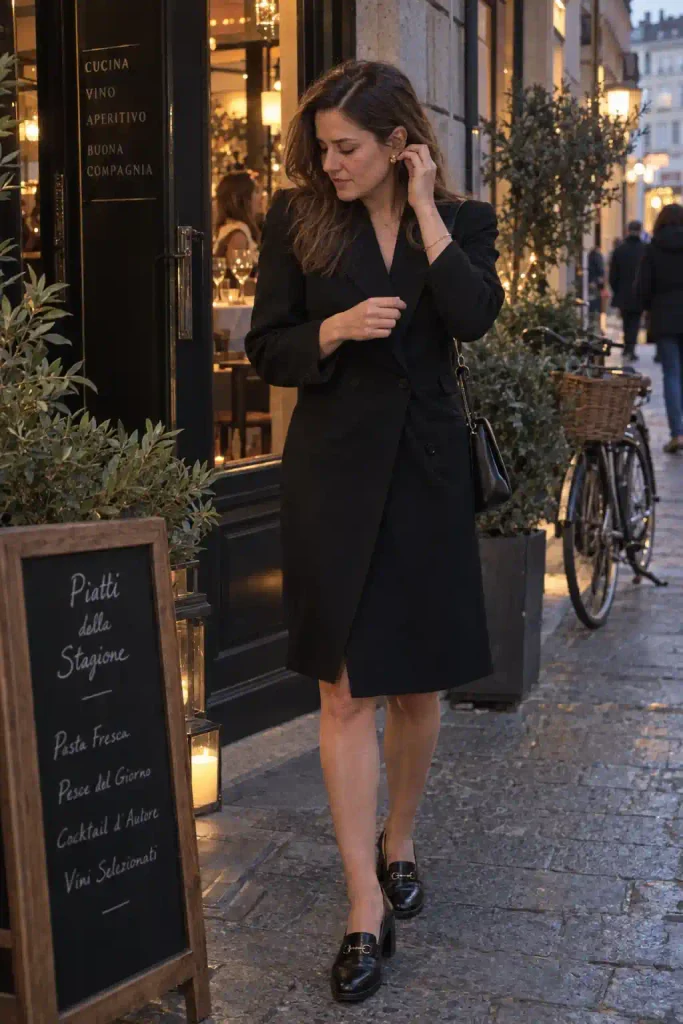
Day 4, city café day: Parisian minimalist. Trench, jeans, flats. Low effort, high payoff.
Day 5, dinner reservation: quiet luxury. One tailored piece, minimal jewelry, done.
Day 6, cold snap or mountain day: Scandi knitwear. Big sweater, boots, beanie, no regrets.
Day 7, flight home: whatever’s cleanest and least wrinkled. No shame in that.
Notice how few actual pieces this requires. Most of these outfits reuse the same coat, the same two pairs of shoes, and a handful of accessories rotated around.
That’s the whole point of building outfits around aesthetics instead of buying single-use pieces you’ll wear once and forget.

The Ultimate College Fall Capsule Wardrobe 24 Easy Outfit Inspo Combinations
Check It Out →FAQs
Do I need a separate coat for every aesthetic? No. One trench or wool coat in a neutral shade works across almost every look on this list. Save your budget for shoes and one statement layer instead.
What’s the single most useful item to pack for fall in Europe? A midweight wool or cashmere sweater. It layers under coats, works alone on warmer days, and pairs with every aesthetic above.
Is it worth packing for rain even in southern Europe? Yes. Fall showers happen even in typically dry regions, and a lightweight packable rain jacket takes up almost no space compared to the regret of getting soaked without one.
Final thought
Pick the aesthetic that actually sounds like you, not the one that looks best on a moodboard.
Comfort wins on day six of a trip every single time, no matter how good the outfit photographs on day one.
So, which look are you building your suitcase around this fall? Save this guide to your Pinterest board and come back to it before you pack.
