
A puffer ski jacket is the one piece in your closet that has to do everything at once.
It needs to survive a chairlift, a snowball fight, and somehow still look decent in your après-ski photos.
I’ve owned four of these jackets over the years, worn two of them until the seams gave out, and learned the hard way that the jacket is only half the outfit.
The rest comes down to what you pair with it. Get that wrong and you look like you’re wearing a sleeping bag with legs.
Get it right and you’re the person everyone asks “wait, where did you get that outfit?”
This guide walks through 14 outfits that actually work, plus the layering logic behind them, so you’re not just warm, you look like you meant to dress this way.
I put this list together after years of trial and error, plus a fair amount of standing around cold parking lots watching other people’s outfits work better than mine.
IMO, most puffer jacket advice online just tells you to “add a beanie” and calls it a day.
That’s not styling, that’s a shrug. Real outfit planning means thinking about proportion, fabric weight, and what you’re actually doing that day, whether that’s skiing, running errands, or heading to dinner straight from the slopes.
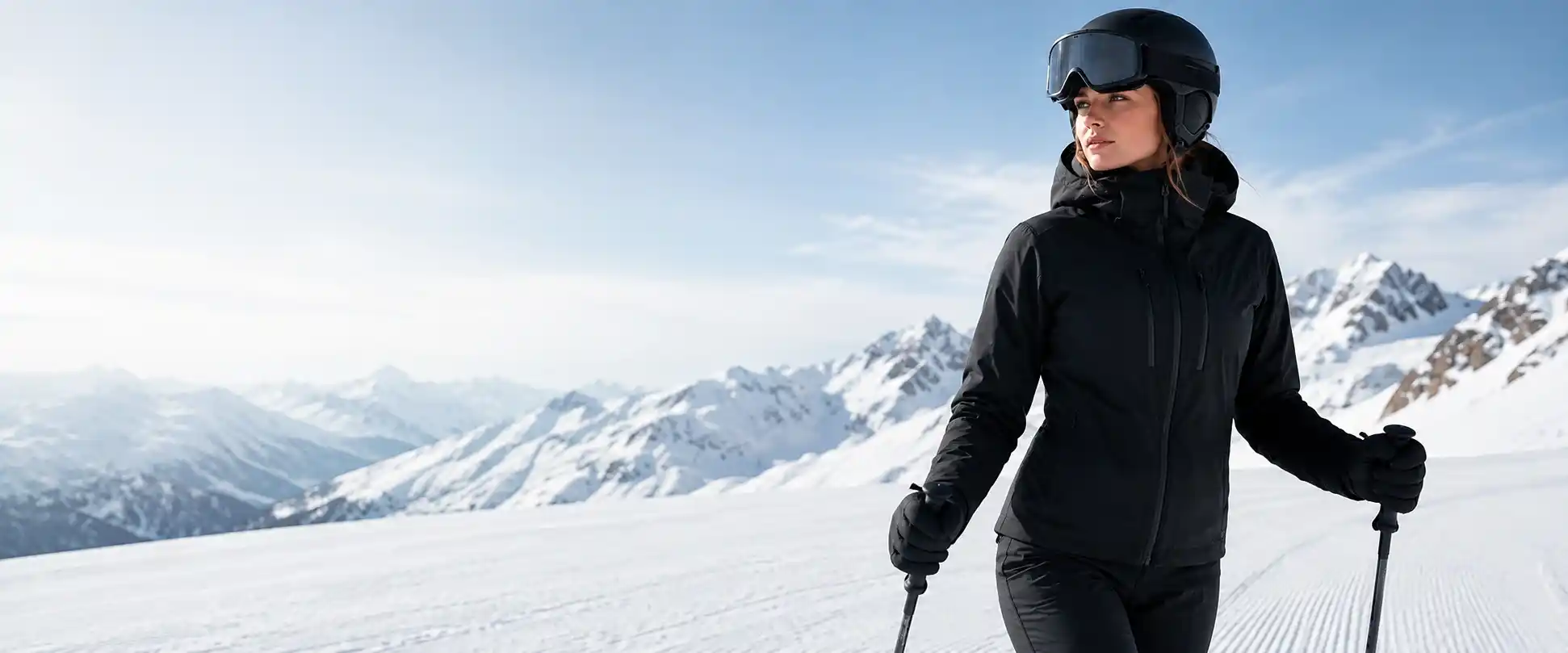
How To Create An All Black Ski Outfit For Women From Base Layer To Boots
Check It Out →Why the puffer jacket is worth building an outfit around

Down and synthetic insulated jackets trap heat close to your body, which is exactly why outdoor retailers push a three-layer system: a wicking base layer, an insulating mid layer, and a protective outer shell, according to REI’s guide to insulated outerwear. Your puffer usually plays the mid or outer role depending on how thick it is.
That matters for styling too. A thick puffer bulks you up, so the pieces underneath and around it need to balance the silhouette instead of adding to it.
That’s the whole trick. Once you get that, outfit planning gets a lot easier.
I run cold, so my puffer collection leans heavy. If you run warm, you can lighten a few of these combos. Adjust as needed, this isn’t a rulebook.
Fit also changes depending on fill type. Down puffers compress and pack down small, which makes them great for travel, but they lose warmth fast when wet.
Synthetic fill holds up better in slush and wet snow, though it’s usually a bit bulkier for the same warmth level.
Neither one is objectively better. It depends on your climate and how much you care about packing your jacket into a small bag at the end of the day.
One more thing worth saying: your puffer doesn’t have to match your ski pants, your gloves, or anything else in a matchy-matchy way.
Some of the best outfits on this list come from mixing textures and slightly clashing tones on purpose.
A little imperfection reads as personal style. Perfect coordination, on the other hand, can look a bit like a store mannequin.
1. The classic base layer and jeans combo
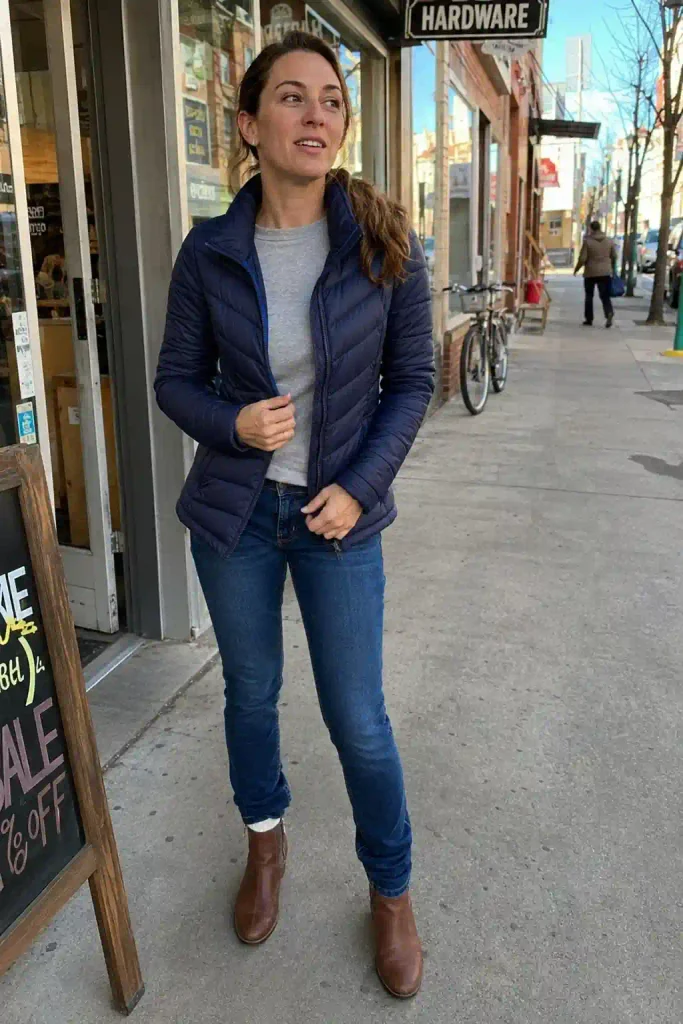
This is the outfit I default to on lazy weekend errands when it’s cold but I’m not actually skiing.
Thermal leggings under straight-leg jeans, a fitted crewneck, and the puffer zipped halfway.
Skip skinny jeans here. They fight the volume of the jacket and end up looking mismatched. Straight or slightly relaxed denim balances the puffed-up top half.
A raw or medium wash denim tends to look more intentional than dark black jeans in this combo, mostly because black jeans plus a black puffer can flatten the whole outfit into one shapeless block.
Add a beanie in a contrasting color and you’ve got an outfit that took five minutes but doesn’t look like it.
2. Puffer jacket with wide-leg trousers
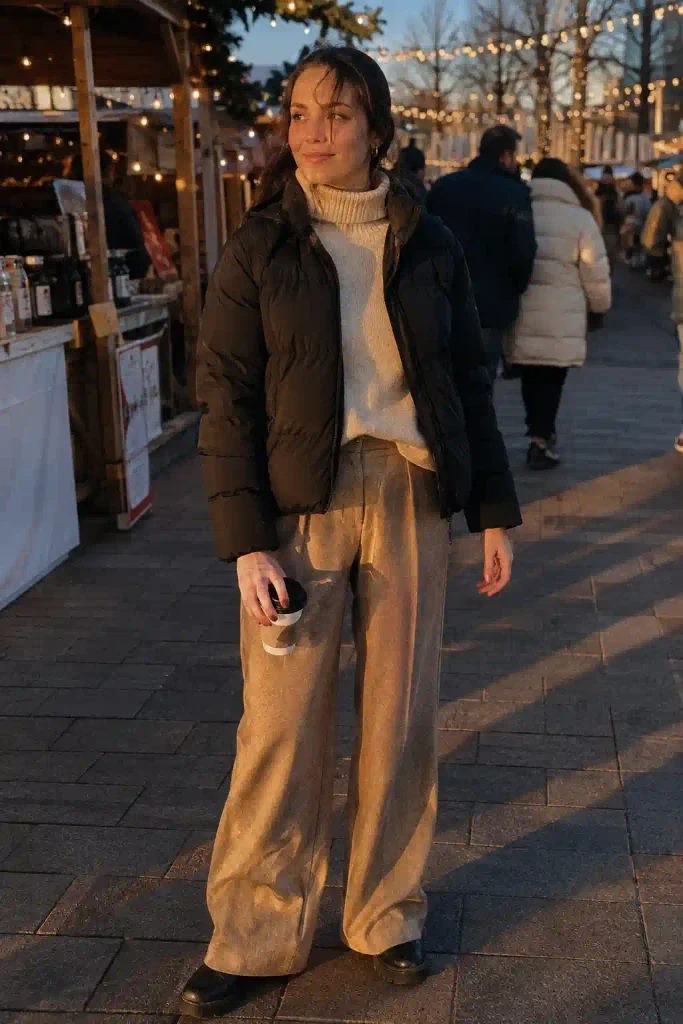
Wide-leg trousers underneath a puffer create a silhouette that’s oddly elegant for something built around a giant marshmallow of a coat.
I wore this to a winter market last year and got three compliments, which for me is basically a viral moment.
Pick a trouser in a heavier fabric like wool blend or corduroy so it holds its shape in the wind.
Tuck in your sweater slightly at the front to avoid looking shapeless from the waist down.
3. Cropped puffer with high-waisted jeans
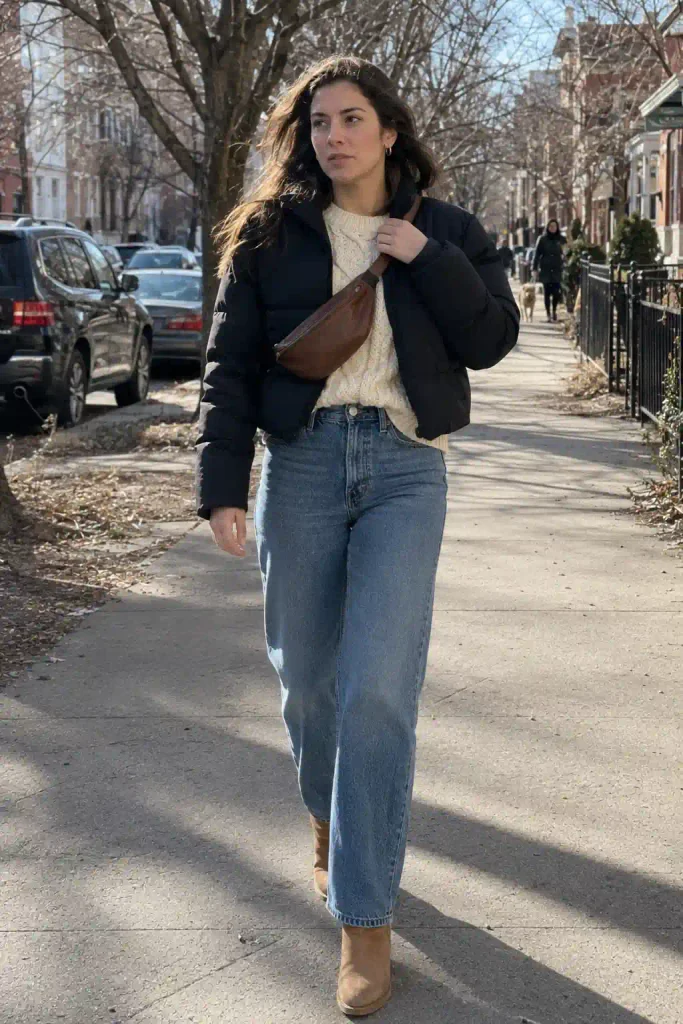
A cropped puffer paired with high-waisted jeans is probably the most photographed combo on Pinterest right now, and honestly, it deserves the attention.
The crop shows off waist definition that a longline puffer completely hides.
- Add a chunky knit sweater underneath, half tucked
- Go for ankle boots, not sneakers, to keep the proportions balanced
- A belt bag across the chest adds a little visual interest without extra bulk
4. Longline puffer as a coat dress
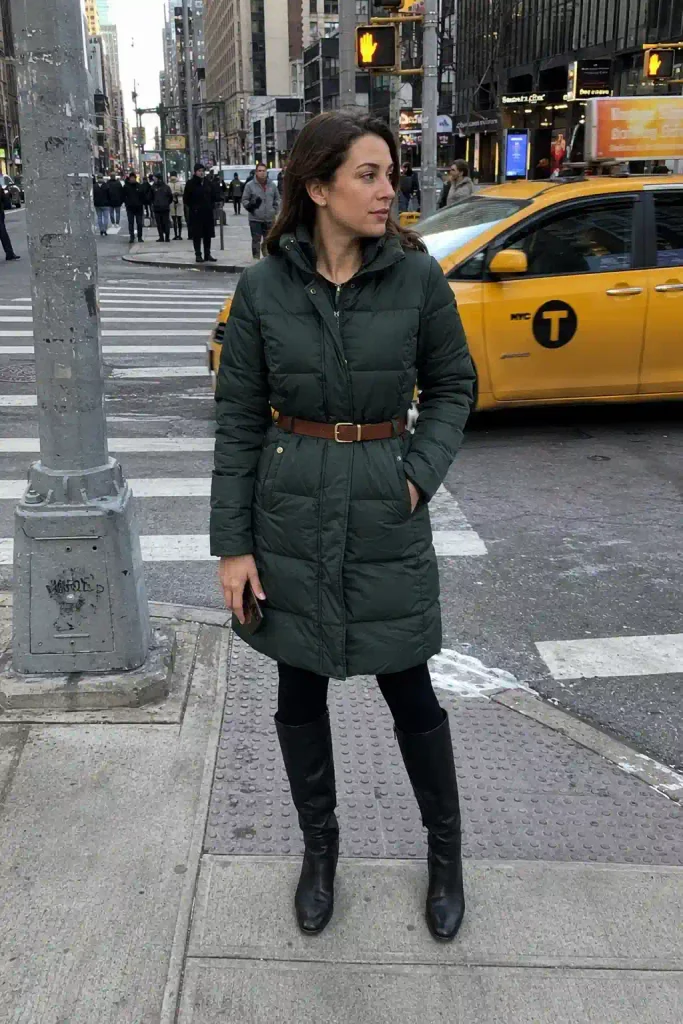
If your puffer hits below the knee, treat it like a coat dress instead of a jacket.
Wear it over leggings and tall boots, cinch it with a belt if it has loops, and skip the extra layers underneath since the length already does the warmth work.
This one surprised me. I bought a long puffer thinking I’d only wear it for actual skiing, and it’s become my go-to for city winters instead.
5. Puffer with a midi skirt and tights
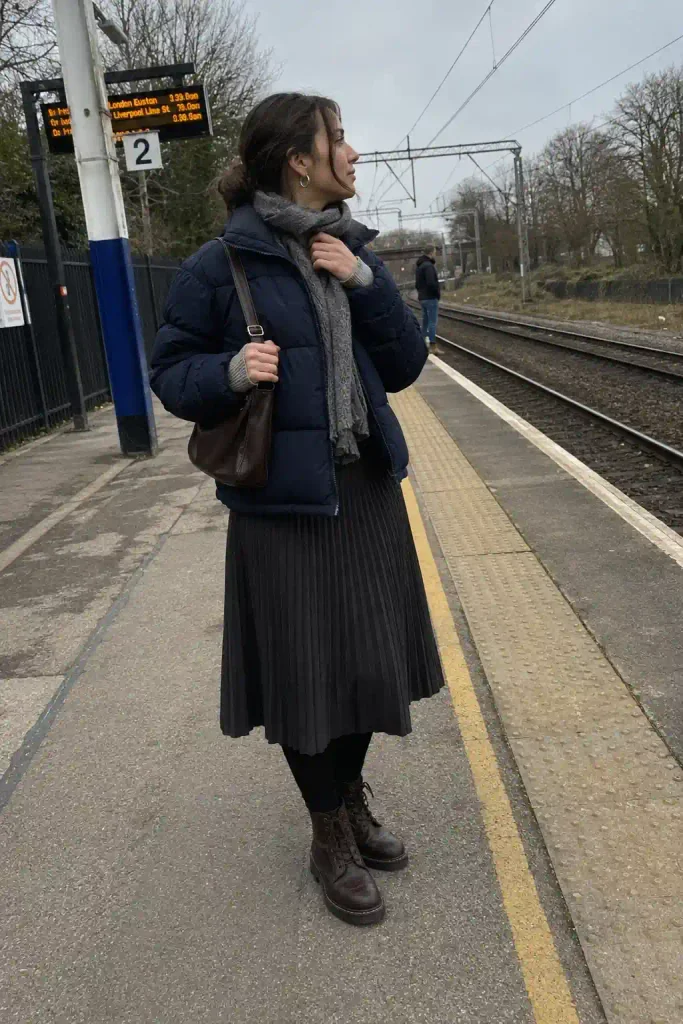
Yes, really. A puffer over a midi skirt with thick tights and combat boots reads as intentional, not accidental.
The trick is choosing a skirt with some structure, pleated or A-line, rather than anything flowy that’ll get lost under the jacket.
This works best for outfits where you’re mostly indoors with short outdoor stretches, like a train platform or a walk between shops. It’s less ideal if you’re standing in snow for an hour.
6. Ski-to-street outfit with matching base layers
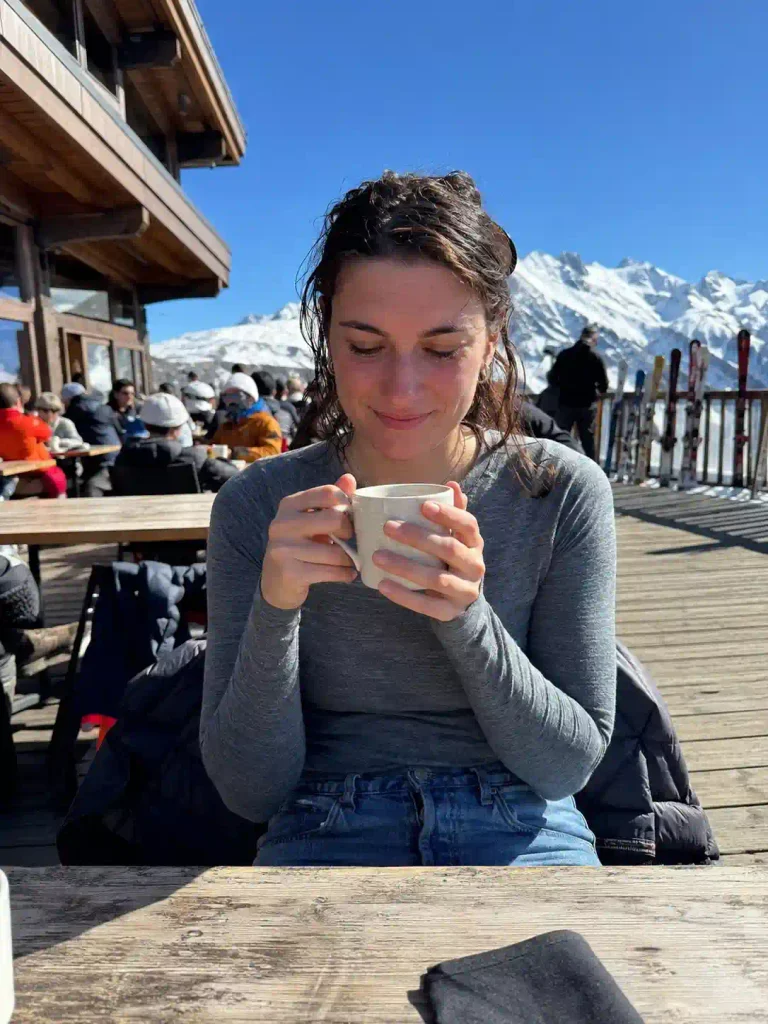
If you’re actually hitting the slopes and then grabbing lunch after, you want an outfit that transitions without a full change of clothes.
REI’s guide on what to wear skiing and snowboarding recommends a moisture-wicking base layer, an insulating mid layer, and a waterproof, breathable outer shell as the foundation.
Choose a base layer in a color you don’t mind showing once you shed the ski pants for jeans at lunch.
Merino wool tops in neutral tones work well here since they don’t look like thermal underwear once you’re off the mountain.
The mistake I made for years was wearing the loudest, most technical base layer I owned, bright orange, giant logo across the chest, because I figured nobody would see it under my jacket anyway.
Then lunch happened, the jacket came off, and I looked like I was still mid-run. Now I keep one plain, dark base layer set specifically for ski-to-street days. Small change, much better photos.
7. Puffer vest layered over a puffer jacket

Double puffer. It sounds excessive until you’re standing at the top of a lift line in negative temperatures and suddenly it makes perfect sense.
Wear a slim puffer vest over your jacket, ideally in a contrasting color, and it reads as a styling choice rather than “I panicked and put on everything I own.”
FYI, this only works if the vest is fitted. A loose vest over a loose jacket just becomes shapeless fabric soup.
8. Monochrome puffer outfit
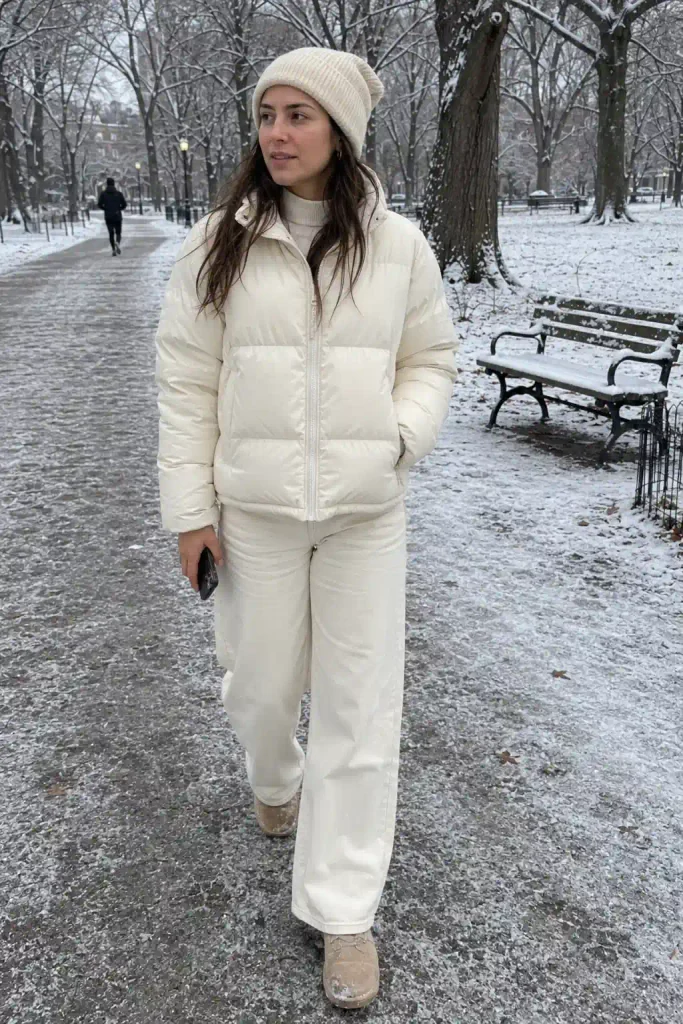
An all-black or all-cream puffer outfit, jacket, pants, boots, hat, all in one tonal family, looks more expensive than it costs.
It’s also the easiest formula on this list because you’re not thinking about color coordination at all.
I lean toward cream in real life because black puffers show every bit of trail dust and lift grease within an hour. Ask me how I know.
9. Puffer with leather leggings
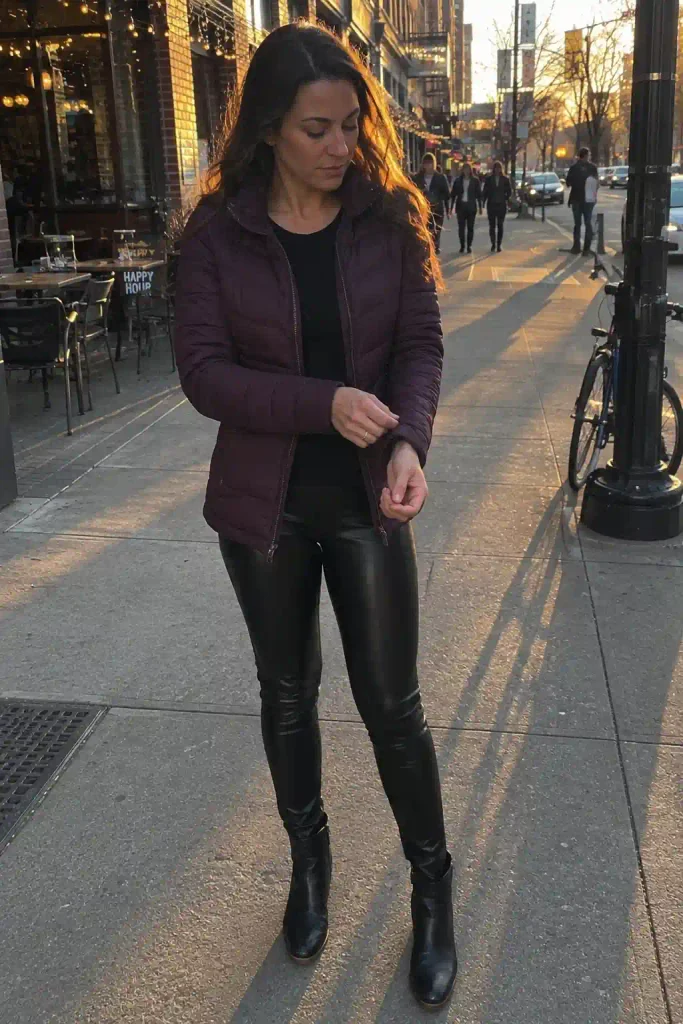
Leather (or faux leather) leggings under a puffer create a nice contrast between the matte, quilted texture of the jacket and the shine of the leggings.
It’s a combo that photographs well, which, let’s be honest, matters if you’re posting the outfit anyway.
Pair with ankle boots and keep accessories minimal. The jacket and leggings are already doing enough visual work on their own.
10. Oversized puffer with fitted layers underneath

If your puffer runs big, lean into it rather than fighting it. Wear a fitted turtleneck and slim pants underneath so the volume stays concentrated in the jacket instead of spreading through the whole outfit.
This is my personal favorite for genuinely freezing days. There’s something about an oversized puffer that just feels like being wrapped in a very stylish duvet.
Boots matter more than usual in this outfit. Chunky, ankle-height boots keep the proportions grounded, while thin sneakers tend to disappear under all that volume and make you look top-heavy.
A small crossbody bag works better than a big tote here too, since a large bag competes with the jacket for space and just adds to the bulk.
11. Puffer with cargo pants for a utility look
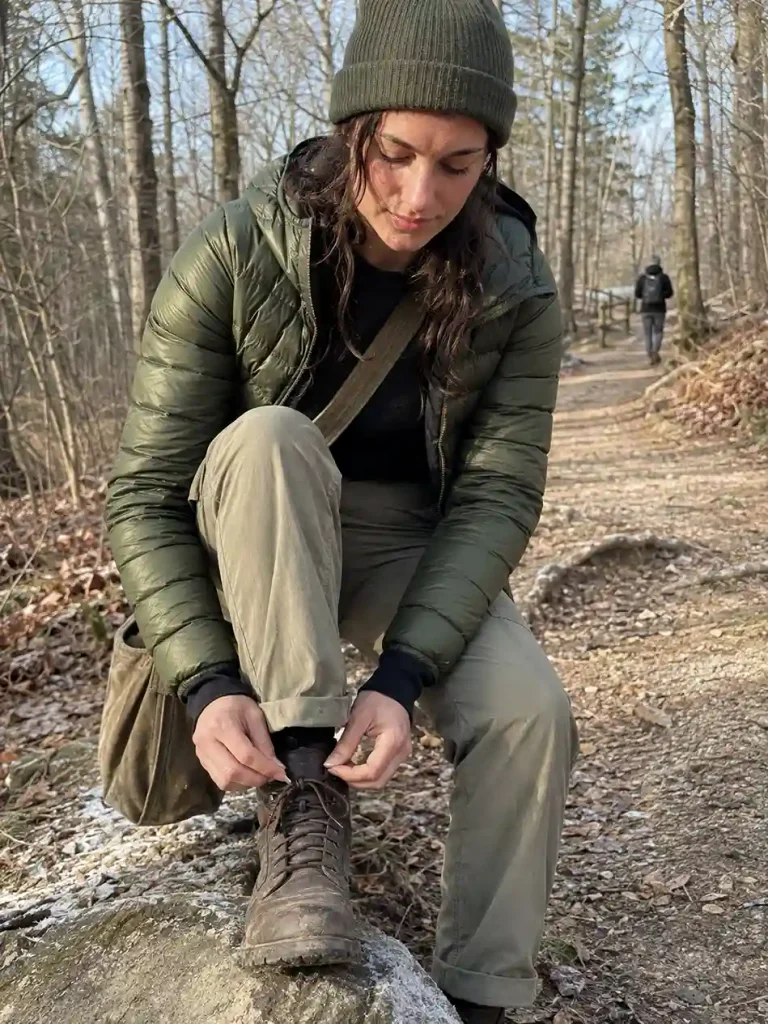
Cargo pants under a puffer jacket lean into a more functional, outdoorsy aesthetic.
Add combat boots and a beanie and you’ve got an outfit that looks like it was built for actual weather, not just for a photo.
- Cuff the cargo pants slightly if they’re loose at the ankle
- Stick to one or two pocket details so the outfit doesn’t get visually busy
- A crossbody bag finishes the utility theme without extra bulk
12. Puffer with a knit dress and boots

A chunky knit dress under a puffer, paired with over-the-knee or mid-calf boots, is one of the warmer options on this list because knitwear traps heat almost as well as your base layer would.
It also happens to look effortless, which is the whole appeal.
According to REI’s guide on dressing in cold weather, dry skin stays warmer than damp skin, so a moisture-wicking layer under the knit dress helps if you’ll be active rather than just standing around.
13. Puffer with matching hat, scarf, and gloves set

Sometimes the simplest move wins. A coordinated hat, scarf, and glove set in one color pulls a plain puffer outfit together without any extra effort. It’s the styling equivalent of a good haircut, low effort, high impact.
Off topic for a second, but I once lost one glove from a matching set on a chairlift and spent the rest of the trip wearing a mismatched glove I found in my car.
Nobody noticed. Nobody cares as much about your gloves as you think they do.
14. Puffer jacket with a slip dress for a night-out contrast
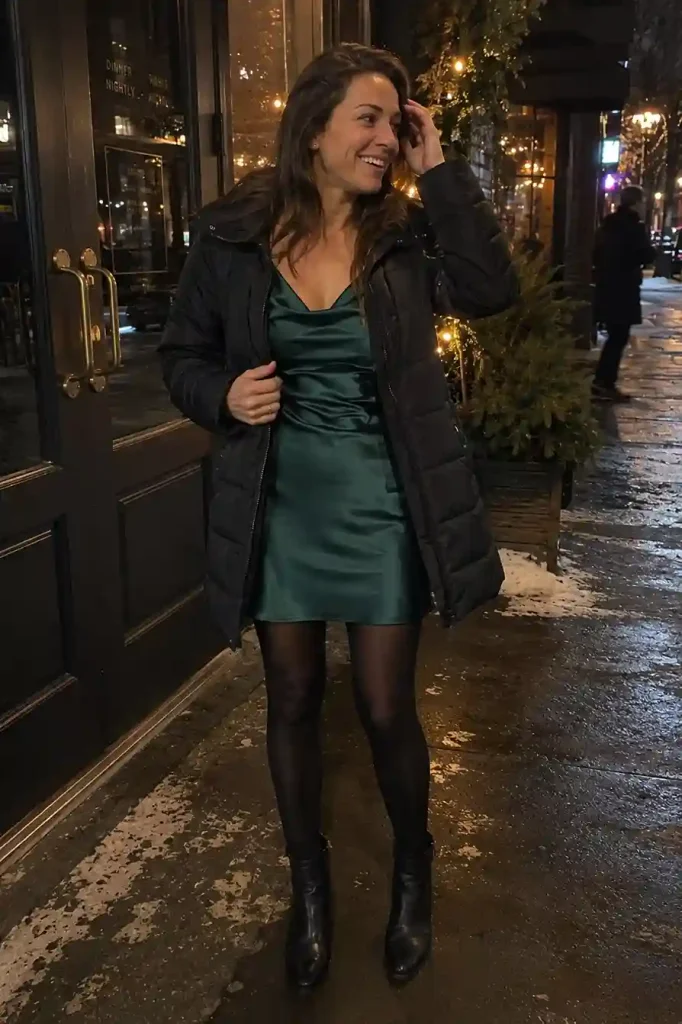
This one’s for the adventurous.
A slip dress under an open puffer jacket, worn as a topper rather than zipped up, creates a contrast between soft and structured that works surprisingly well for a winter night out.
Add tights and boots underneath for warmth without ruining the silhouette.
Wow, this sounds like it shouldn’t work on paper, but it genuinely does. Just don’t try it below freezing unless your car is parked directly outside.
Quick reference: matching your puffer style to the outfit
| Puffer style | Best paired with | Occasion |
|---|---|---|
| Cropped puffer | High-waisted jeans, midi skirts | Casual daytime, coffee runs |
| Longline puffer | Leggings, tall boots | City winters, commuting |
| Ski-specific puffer | Base layers, ski pants | Actual slope days |
| Oversized puffer | Fitted turtlenecks, slim pants | Extreme cold, lounging outdoors |
A note on fit before you buy

If you’re shopping for a new puffer rather than styling one you already own, fit matters more than the outfit around it.
Spyder’s guide to layering for skiing points out that shells and insulated jackets serve different purposes, shells offer flexibility for active days, while insulated jackets suit cold lift rides or standing around a lot.
Try the jacket on over the base layer and mid layer you’d actually wear, not just a t-shirt.
A jacket that fits over nothing will feel tight the moment you add real layers underneath it.
I learned this after buying a jacket a size too small and spending a whole season unable to fully zip it over a sweater.
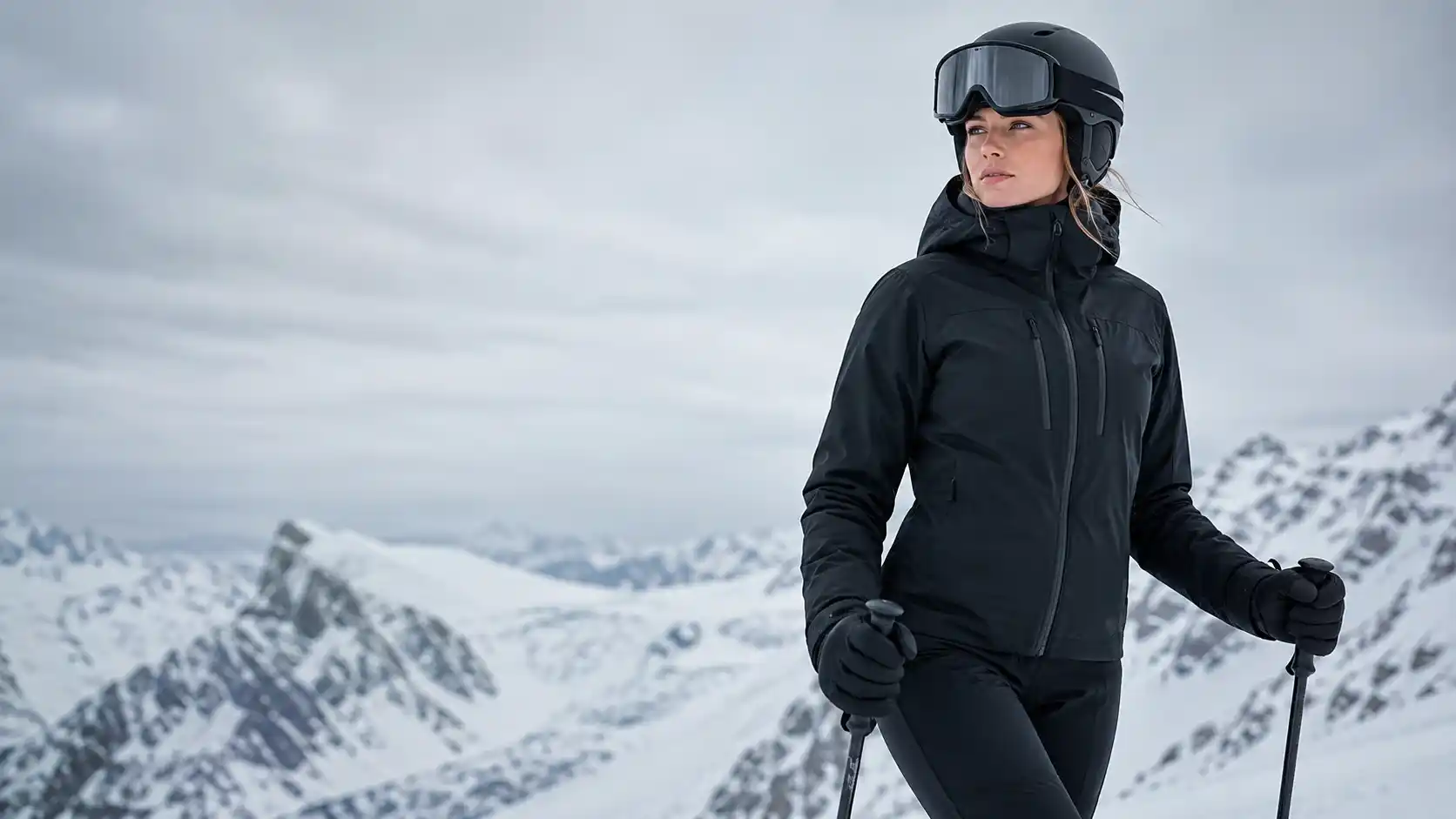
Sleeve length matters more than most people check for. If the cuffs ride up past your wrist when you raise your arms, you’ll feel a cold gap every single time you reach for a chairlift bar or a coffee cup.
Check the hood too, especially if you wear a helmet.
A hood that’s too small won’t fit over a helmet, and one that’s too large will just flop around and block your peripheral vision.
Small details, but they’re the ones that decide whether you actually enjoy wearing the jacket or just tolerate it.
It’s also worth thinking about hem length relative to your ski pants or jeans.
A gap of bare skin between your jacket hem and your waistband is a fast way to let cold air in, no matter how warm the jacket itself is.
Uncommon Path, REI’s own publication, points out that a good outer layer should work as part of a full system rather than as a standalone piece, and that logic holds true whether you’re building a layering system for the outdoors or just picking an outfit for a cold city day.
Frequently asked questions
Can I wear a puffer jacket for everyday outfits, not just skiing? Yes. Plenty of puffer jackets are designed for city wear rather than the slopes. Look at the fill weight and shell fabric.
A lighter fill with a soft finish tends to work better for daily outfits than a heavy-duty ski-specific puffer.
What should I avoid wearing under a puffer jacket? Avoid anything too bulky underneath, like another thick sweater plus a scarf plus a hood, since it’ll make the whole outfit feel stiff and hard to move in. One solid mid layer is usually enough.
Does a puffer jacket work for formal or semi-formal winter events? It can, if you treat it as a topper over a nicer outfit like a slip dress or tailored trousers, and remove it once you’re indoors. It’s less about the jacket itself and more about what’s underneath it.
So, which of these 14 are you actually going to try first? Save this for your next cold-weather outfit planning session, or better yet, pin your own puffer look and tag it.
I’d genuinely love to see what you put together, cold weather styling is more fun when it’s a group project.
